

Client Conversion Funnel Blueprint: The Digital Coach's Guide to Consistent Income
Master Marketing Funnels: Attract Your Ideal Clients, Nurture Leads, & Scale Your Online Business with Predictable Strategies & Actionable Steps.

Hii coaches!
Imagine waking up to new leads in your inbox, knowing exactly how to turn curious followers into loyal clients, and having a system that works tirelessly for your business, even while you sleep. Does that sound like a dream? For many digital coaches and creators, it feels exactly like that – a constant hustle, inconsistent income, and the exhausting cycle of chasing new clients.
But what if there was a better way? A strategic, predictable, and scalable system that brings your ideal clients to you, builds deep trust, and guides them seamlessly to your paid offers?
The Client Conversion Funnel
This isn't just another marketing buzzword; it's the foundational blueprint for a thriving online business. For digital coaches, online course creators, consultants, and service-based entrepreneurs, a well-crafted marketing funnel is the difference between a sporadic income and a consistent, predictable revenue stream. It allows you to move beyond the feast-or-famine cycle, giving you the freedom to focus on what you do best: transforming lives and delivering incredible value.
In today’s deep-dive, we’re going to pull back the curtain on funnels. We’ll start from the absolute basics, demystify the jargon, and then guide you, step-by-step, through building, optimizing, and scaling your very own client conversion funnel. Our goal is to empower you with a "how-to" guide that you'll want to bookmark, reference, and use to build the sustainable, impactful business you deserve.
Let’s unlock the power of predictable growth!
Part 1: The Funnel Explained (The Big Idea Behind Predictable Client Acquisition)
At its core, a marketing funnel is simply a visual representation of the journey your potential client takes with your brand. It’s a strategic roadmap designed to guide them from being a complete stranger who has never heard of you, to a loyal, raving fan and paying client. Think of it less as a sales pitch and more as a carefully curated relationship-building process.
1.1. What Exactly is a Funnel? The Client Journey Analogy
Forget the image of a cold, impersonal sales machine. For coaches and creators, a funnel is about building trust, demonstrating value, and solving problems, all before you even ask for the sale.
Imagine a real-life journey:
The Unaware Traveler (Top of Funnel): Someone is walking down a busy street, not actively looking for a café. They just notice a pleasant aroma.
The Curious Explorer (Middle of Funnel): They see a sign for "The Best Coffee in Town" and step inside, intrigued. They look at the menu, maybe grab a free sample, and chat with the barista.
The Ready-to-Buy Customer (Bottom of Funnel): They love the atmosphere and the sample. They’ve decided to buy a coffee, perhaps even a pastry.
The Loyal Patron (Post-Purchase): They enjoyed the experience so much, they come back regularly, tell their friends, and maybe even join the loyalty program.
Your online client conversion funnel works in precisely the same way. It's about leading your audience through a series of intentional steps, providing value at each stage, and building rapport until they are ready and eager to invest in your coaching, course, or service.
Why this matters for YOU as a coach/creator:
Predictability: No more guessing where your next client will come from. Funnels provide a structured system.
Scalability: Once built, a funnel can work for thousands of people just as easily as it works for ten.
Trust & Authority: You establish yourself as the expert by providing value upfront, making your eventual offer a natural progression, not a sudden pitch.
Efficiency: Automate the nurturing process, freeing up your time to focus on client delivery and content creation.
1.2. Deconstructing the Client Funnel: The Three Core Stages (and Beyond)
While there are many variations, most marketing funnels can be broken down into three primary stages. Understanding the mindset of your prospect at each stage is crucial for crafting the right message and content.
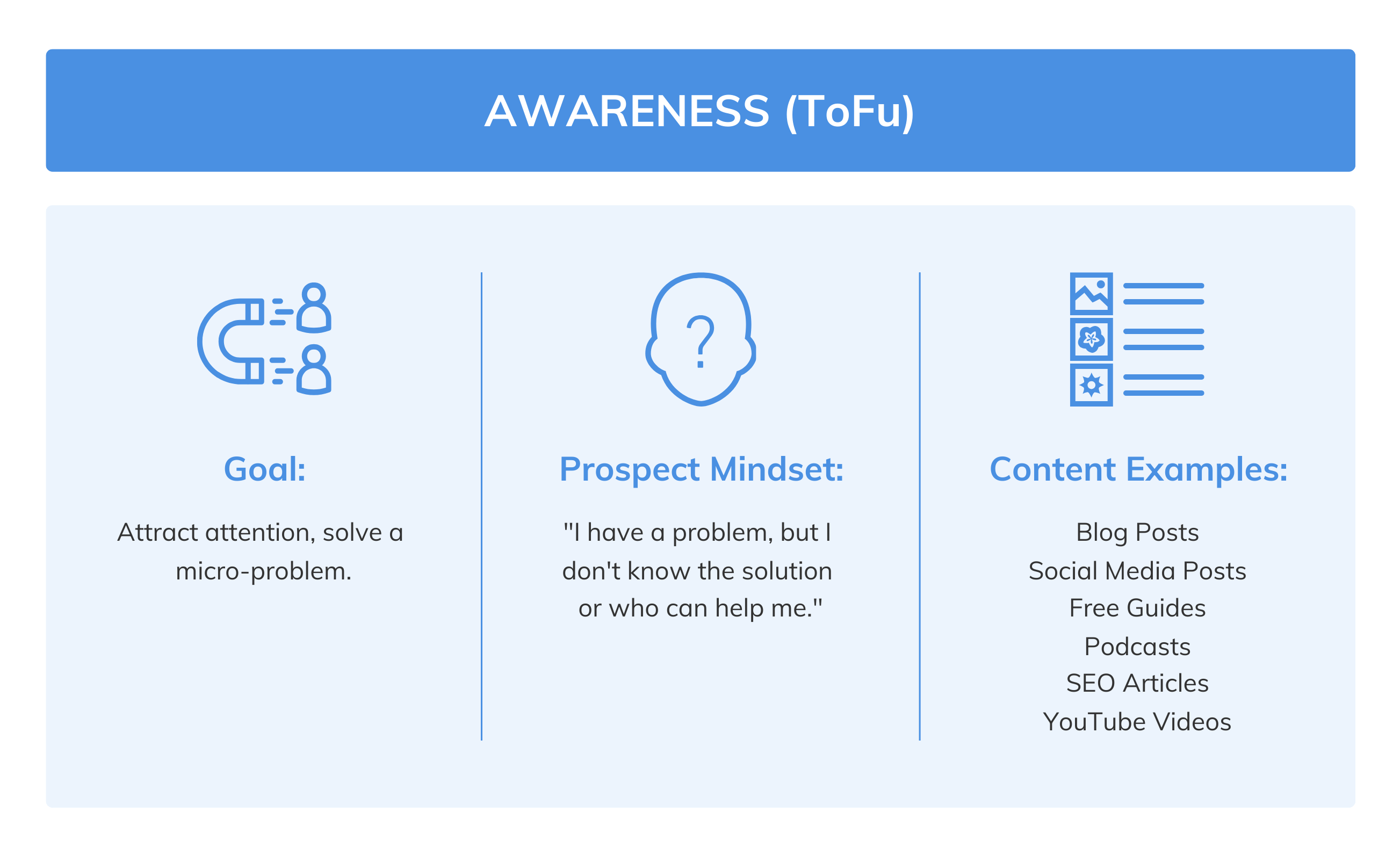
A. Top of Funnel (ToFu): The Awareness Stage – Attract
The Goal: To capture the attention of a broad audience who might be experiencing the problem you solve, but who may not yet be aware of your brand or even that a solution exists. This is about casting a wide net.
Prospect Mindset: At this stage, your ideal client is often searching for answers to a specific pain point or curiosity. They're asking questions like, "How do I grow my Instagram following?" or "What's the best way to get over procrastination?" They're not looking to buy, they're looking for information.
Your Role: Be a helpful resource. Provide valuable, easy-to-consume content that addresses their initial pain points without asking for anything in return. This content should be easily discoverable where your ideal client hangs out online.
Content Examples:
Blog Posts/Articles: "5 Ways to Beat Creative Burnout," "The Ultimate Guide to Launching Your First Podcast."
Social Media Content: Engaging Instagram reels, TikTok videos, LinkedIn posts addressing common industry myths or quick tips.
YouTube Videos: "How-to" tutorials, explainer videos, Q&A sessions.
Podcast Episodes: Interviewing experts, deep-diving into specific challenges.
SEO-Optimized Content: Articles that rank high on Google for relevant keywords.
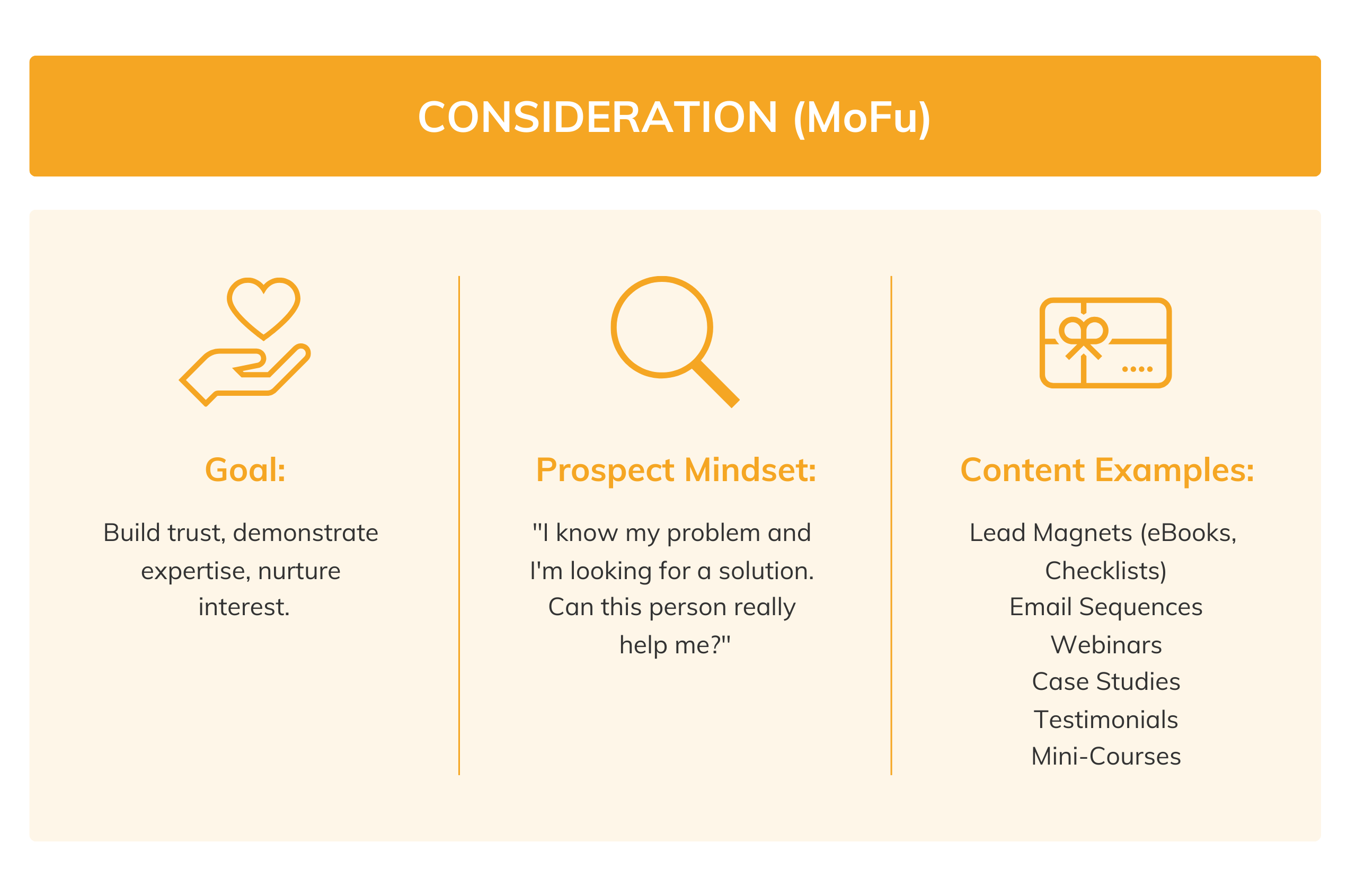
B. Middle of Funnel (MoFu): The Consideration Stage – Nurture
The Goal: Once you've captured their attention, the MoFu is where you nurture that budding interest. You want to build trust, establish your authority as an expert, and help them understand how you can solve their problem. This is where you transition them from an anonymous visitor to a known lead (usually by getting their email address).
Prospect Mindset: They're now more engaged. They know they have a problem and they're actively seeking solutions. They're comparing options, researching different approaches, and evaluating potential coaches or creators. They're thinking, "This person seems to know what they're talking about. Can they actually help me?"
Your Role: Offer deeper, more valuable content in exchange for their contact information. Continue to educate and inspire, showcasing your unique approach and the results you deliver.
Content Examples:
Lead Magnets: Free e-books, detailed checklists, templates, mini-workbooks, resource guides (e.g., "The 7-Step Course Launch Checklist," "Your Personal Brand Story Template").
Webinars/Masterclasses: Live or pre-recorded training that dives deep into a specific topic, offering solutions and insights.
Email Sequences: A series of automated emails designed to deliver value, share testimonials, tell your story, and build rapport after they've opted into your lead magnet.
Case Studies: Detailed stories of how you've helped previous clients achieve specific results.
Quizzes/Assessments: Interactive tools that help prospects identify their challenges and suggest solutions (which you provide).
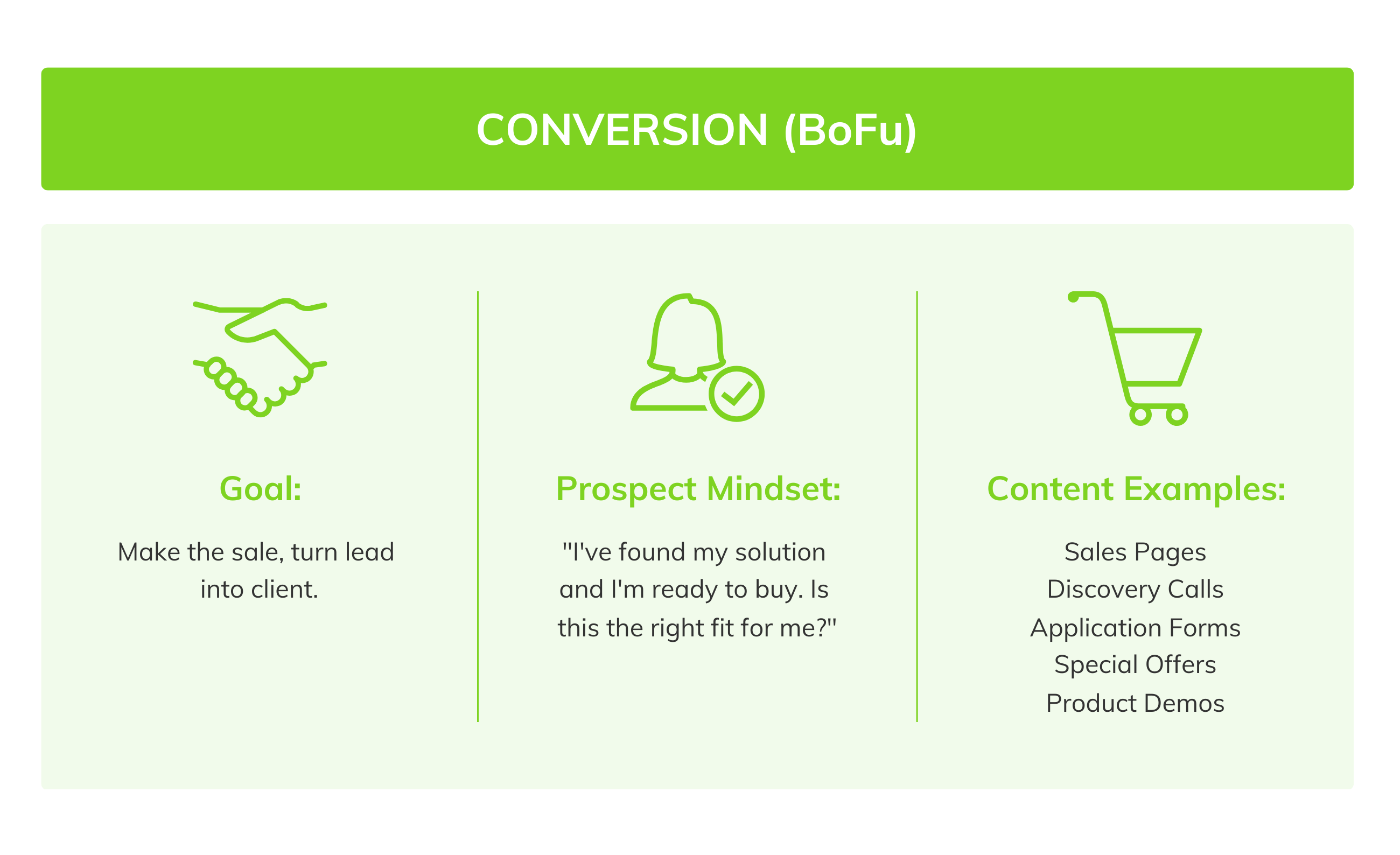
C. Bottom of Funnel (BoFu): The Conversion Stage – Convert
The Goal: This is where you make your offer. Having nurtured them and demonstrated your value, your prospect is now ready to make a decision. The goal here is to convert them into a paying client.
Prospect Mindset: They are well-informed, trust you, and believe you can help them achieve their desired outcome. They're asking, "Is this the right solution for me? Is now the right time? What's the investment, and what will I get?"
Your Role: Present your paid offer clearly, concisely, and compellingly. Address any remaining objections, reiterate the benefits, and provide a clear call to action.
Content Examples:
Sales Pages: Dedicated web pages that detail your course, coaching program, or service, outlining benefits, modules, testimonials, pricing, and FAQs.
Discovery/Strategy Calls: One-on-one calls for high-ticket services where you explore their needs and determine if your offering is a good fit.
Application Forms: For selective coaching programs, ensuring you work with ideal clients.
Time-Sensitive Offers/Bonuses: Creating urgency and incentive to make a decision.
Product Demos: For software or platform-based offers.
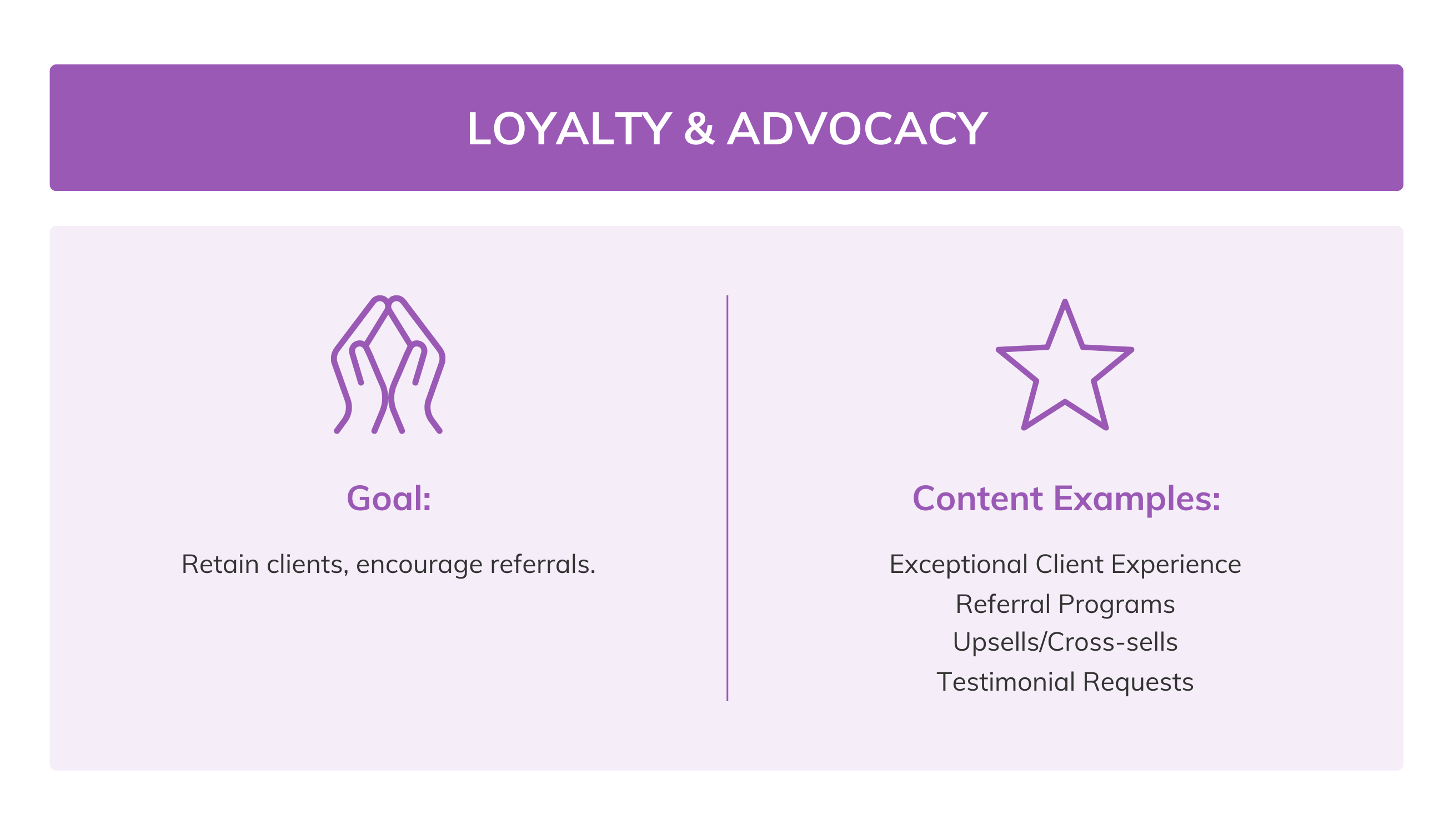
D. Beyond the Sale: Loyalty & Advocacy (The Post-Purchase Funnel)
The Goal: The funnel doesn't end with a sale! This crucial stage focuses on retaining clients, ensuring their success, and turning them into raving fans who refer others.
Your Role: Deliver exceptional value, provide ongoing support, and create opportunities for clients to share their success.
Content Examples: Onboarding sequences, client communities, surprise bonuses, referral programs, requests for testimonials/case studies, upsell/cross-sell opportunities for related programs.
Part 2: Building Your Funnel from Scratch (The Actionable Blueprint)
Now that we understand the 'what' and 'why,' let's get into the 'how.' Building a powerful funnel doesn't require complex coding or a massive budget. It requires clarity, strategy, and consistent action.
2.1. Step 1: Laying the Foundation – Crystal Clear Client & Offer
Before you design a single landing page or write an email, you must have unwavering clarity on two things:
A. Who are you talking to? Your Ideal Client Persona.
This is the single most critical step. If you're talking to everyone, you're talking to no one. Go beyond basic demographics.
Questions to ask:
What are their biggest struggles and pain points? (What keeps them up at night?)
What are their deepest desires and aspirations? (What do they dream of achieving?)
What beliefs or misconceptions do they have about solving their problem?
Where do they hang out online? (Which social media platforms, forums, podcasts?)
What language do they use to describe their problem and desired outcome?
What are their current behaviors related to your niche?
What stops them from taking action? (Objections, fears)
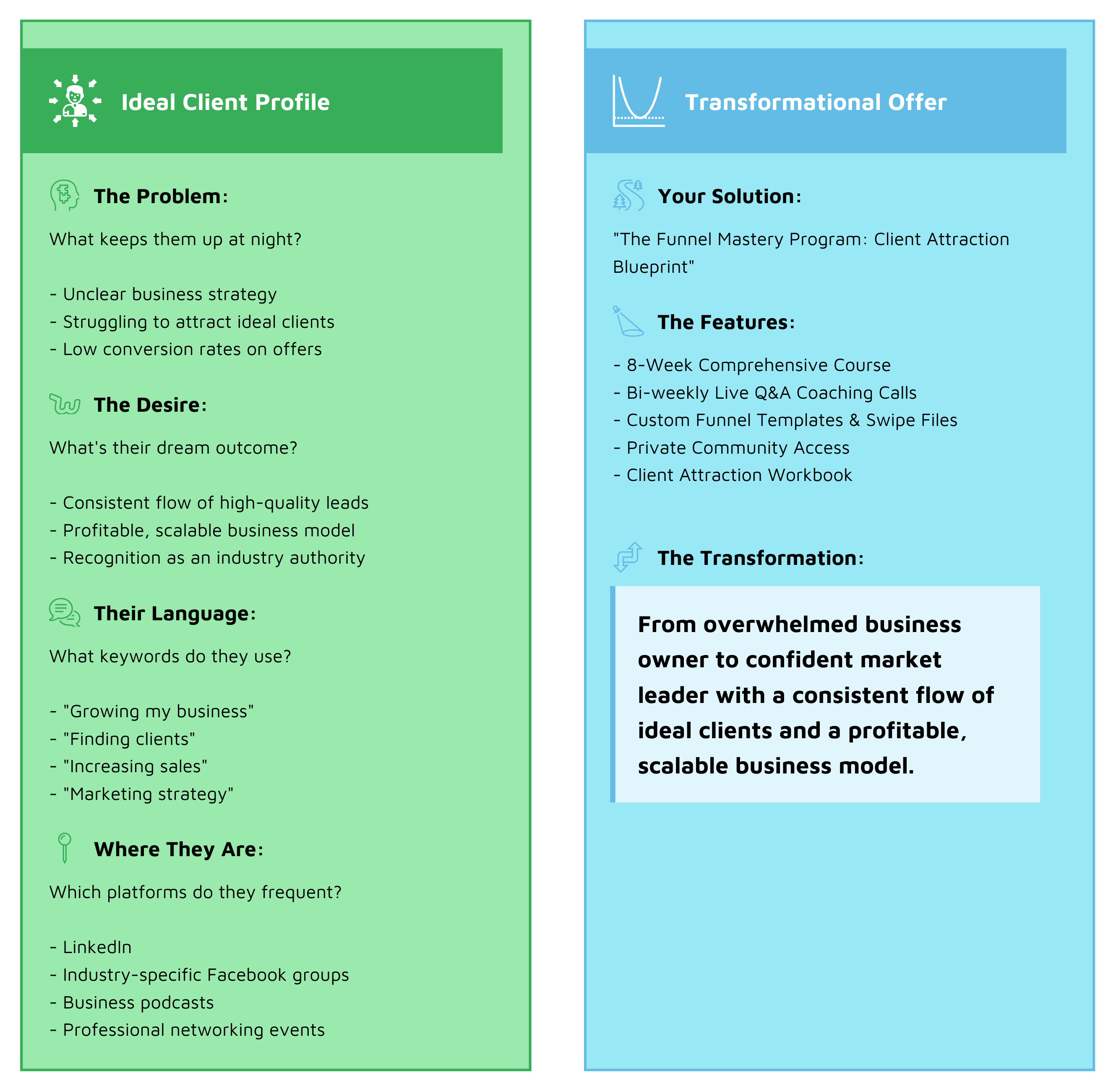
B. What are you selling? Your Core Offer & Its Transformation.
Your funnel exists to sell something. Be clear on what that is. Is it a 1:1 coaching package, a group program, an online course, a membership?
Focus on the Transformation, Not Just the Features: Don't just list what's included ("12 modules," "3 coaching calls"). Instead, articulate the outcome your client will achieve. "Go from overwhelmed to organized," "Turn your passion into profit," "Build a thriving online community."
Clarity = Conversion: A clear, compelling offer that directly addresses your ideal client's pain points and promises a desired transformation is the cornerstone of a high-converting funnel.
2.2. Step 2: Choosing Your Funnel Type (The Right Fit for Your Business)
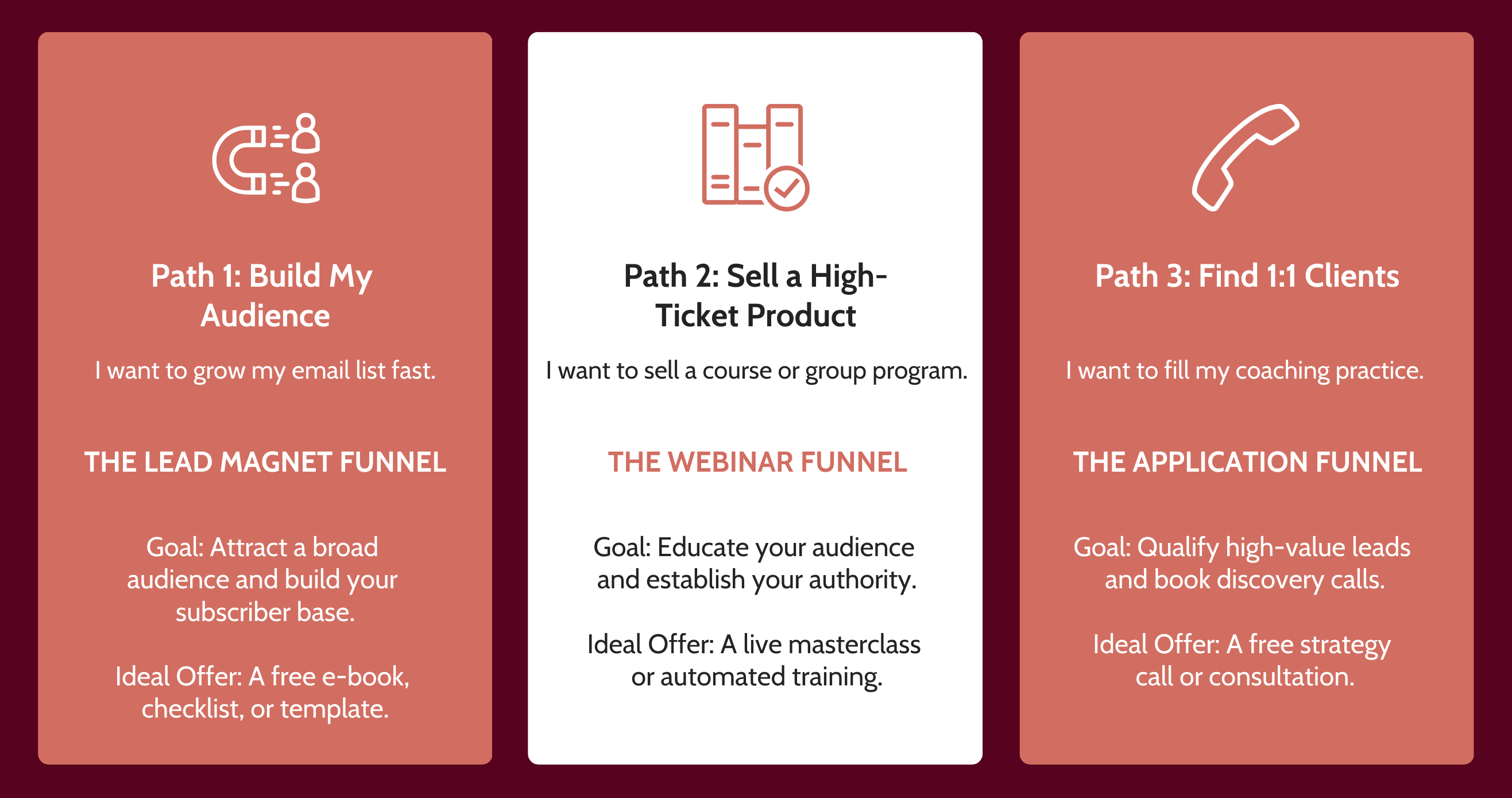
There isn't one "perfect" funnel. The best funnel for you depends on your offer, your audience, and your business goals. Here are some of the most common and effective funnel types for coaches and creators:
A. The Lead Magnet Funnel (Building Your Email List):
Purpose: To quickly grow your email list by offering a valuable free resource in exchange for an email address. This is often the foundational funnel for any online business.
Flow:
Traffic Source: Social media, blog post, podcast, paid ads.
Opt-in Page (Landing Page): Highlights the benefits of your free lead magnet.
Lead Magnet Delivery: Automated email delivering the resource.
Nurture Email Sequence: 3-7 automated emails providing more value, building trust, and eventually leading to a low-ticket or core offer.
Best For: Almost anyone! Especially great for coaches selling courses or programs where email marketing is key.
Example Lead Magnets: "The 10-Step Guide to Launching Your Podcast," "5 Productivity Hacks for Online Entrepreneurs," "Your Personal Brand Story Template."
B. The Webinar Funnel (Selling High-Ticket Offers):
Purpose: To provide extensive value and deep insights, establishing expertise and building a strong connection, often leading to the sale of a higher-priced course or coaching program.
Flow:
Traffic Source: Social media, email list, paid ads.
Webinar Registration Page: Sells the benefits of attending the live (or evergreen) masterclass/webinar.
Reminder Emails/SMS: Builds anticipation.
The Webinar: Delivers massive value, then transitions into a pitch for your paid offer.
Post-Webinar Follow-up: Emails with replays, FAQs, and a strong call-to-action to buy.
Best For: Selling high-ticket coaching programs, comprehensive online courses, or group masterminds.
C. The Application/Discovery Call Funnel (For 1:1 Coaching):
Purpose: To qualify leads for high-end, personalized 1:1 coaching services, ensuring you only spend time on calls with truly ideal prospects.
Flow:
Traffic Source: Content marketing (blog, podcast, YouTube), referrals, lead magnet funnel follow-up.
Call-to-Action: Directs prospects to "Apply for a Free Strategy Call" or "Book a Discovery Session."
Application Form: Asks qualifying questions (e.g., current challenges, goals, budget expectations).
Scheduling Page: Only qualified applicants receive a link to book a call.
Discovery Call: A strategic conversation to assess fit and present your coaching package.
Best For: High-ticket, bespoke 1:1 coaching, consulting, or done-for-you services where client-coach fit is paramount.
D. The Tripwire Funnel (Low-Barrier Entry Offer):
Purpose: To convert a prospect from a lead into a paying customer with a low-cost, high-value offer, making them more likely to purchase higher-ticket items later.
Flow:
Traffic Source: Social media, blog posts.
Opt-in Page (for a free lead magnet)
One-Time Offer (OTO) / Tripwire Page: Immediately after they opt-in for the freebie, present a compelling, low-priced offer ($7-$47) that complements the freebie.
Upsell/Downsell (Optional): Offer a slightly higher-priced item if they buy the tripwire, or a lower-priced item if they decline.
Nurture Sequence: For those who purchased the tripwire, a sequence that delivers the product and introduces your core offer.
Best For: Creating micro-conversions, segmenting buyers from non-buyers, and building an audience of paying customers.
2.3. Step 3: Mapping Out Your Funnel Flow (The Visual Game Plan)
Once you've chosen your funnel type, it's time to visualize it. This is where your "Build Your First Funnel" worksheet will come in handy.
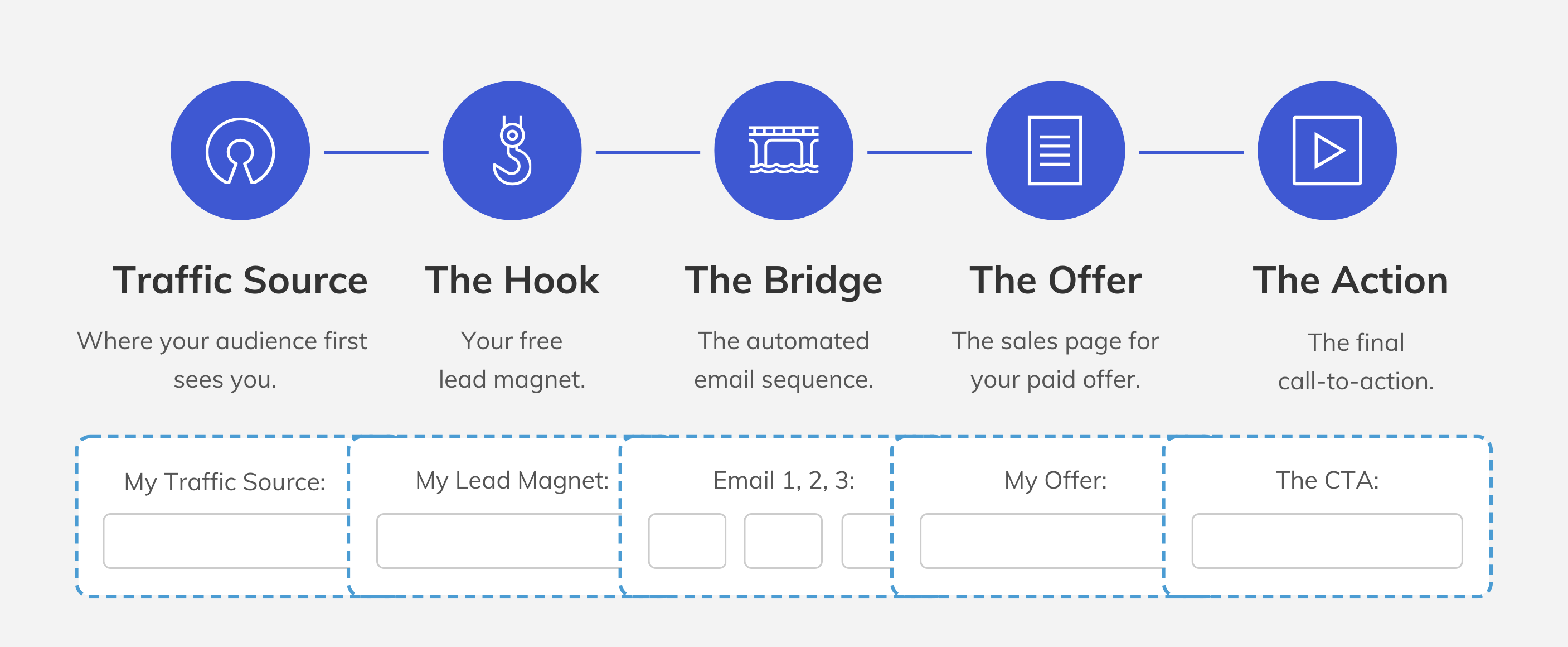
Draw it out: Seriously, grab a pen and paper or use a simple digital tool. Draw boxes for each step and arrows indicating the flow.
For each step, identify:
What content/page is needed? (e.g., social media post, landing page, email 1, email 2, sales page).
What is the goal of this step? (e.g., "get an email address," "build trust," "make the sale").
What is the call-to-action (CTA)? (e.g., "Download Now," "Watch the Free Training," "Apply Here," "Buy Now").
Think like your ideal client: Walk through your funnel from their perspective. Is it clear? Is there too much friction? Does each step make sense?
2.4. Step 4: Your Essential "Funnels Tech Stack" (Tools You'll Need)
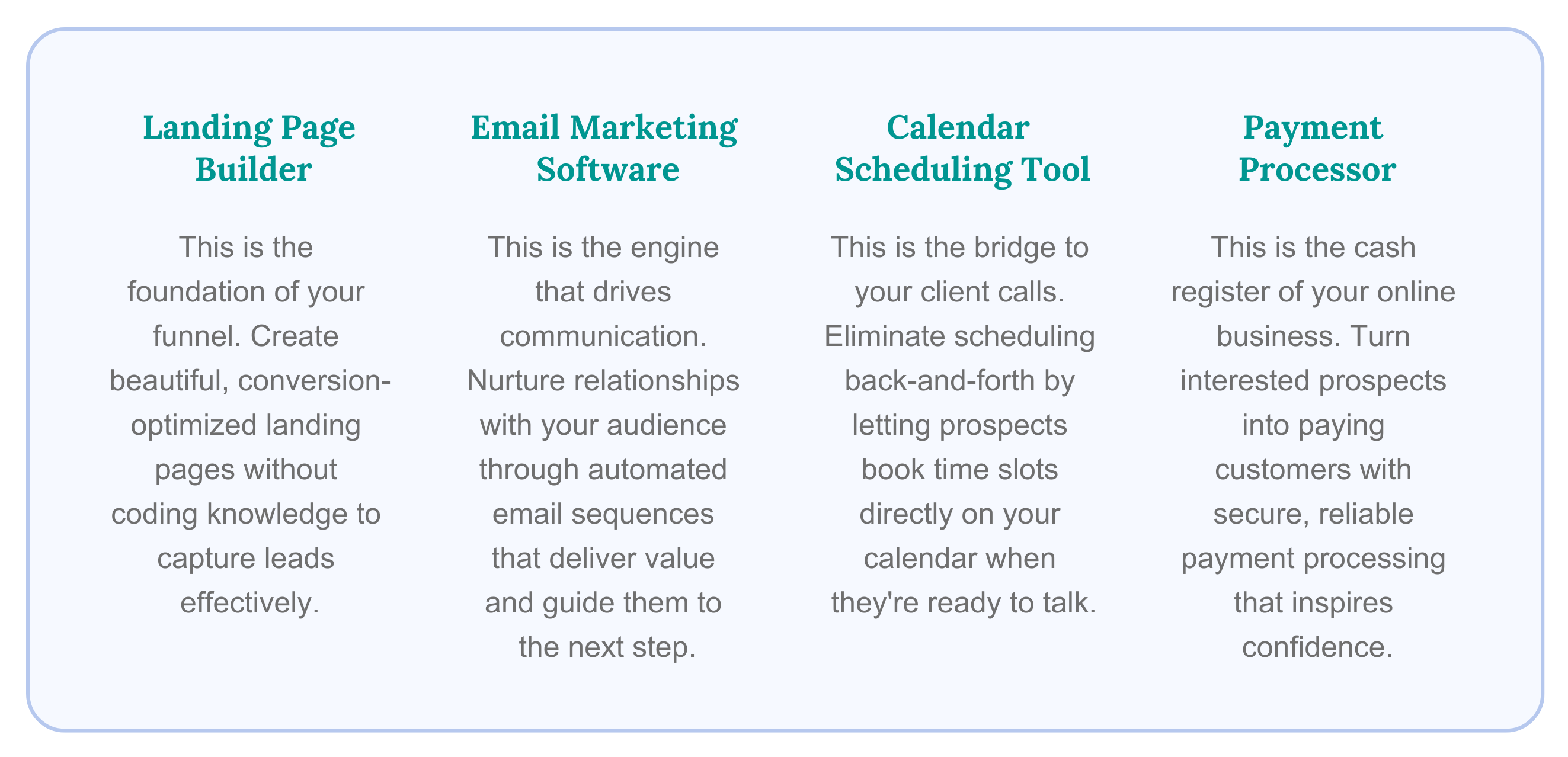
You don't need dozens of expensive tools, but a few key platforms will automate much of your funnel's heavy lifting. Many of these offer free trials or affordable starter plans.
A. Landing Page Builder:
Purpose: To create high-converting opt-in pages, sales pages, webinar registration pages, and thank you pages without needing to code.
Key Features: Drag-and-drop editor, mobile responsiveness, A/B testing capabilities, integration with email services.
Examples (for context, not specific recommendations): TagMango, Leadpages, ClickFunnels, Unbounce, Instapage, or even website builders like Squarespace/WordPress with specific plugins.
B. Email Marketing Software (Autoresponder):
Purpose: To collect email addresses, send automated welcome sequences, nurture campaigns, and broadcast one-off emails. This is the heart of most funnels.
Key Features: Email list management, segmentation, automation workflows, analytics (open rates, click-through rates).
Examples: ConvertKit (popular with creators), Mailchimp, ActiveCampaign, Aweber.
C. Calendar Scheduling Tool (for Discovery Funnels):
Purpose: To allow prospects to easily book time on your calendar, eliminating back-and-forth emails.
Key Features: Integration with your calendar, automated reminders, customizable booking pages.
Examples: Google Calendar, Calendly, Acuity Scheduling, SavvyCal.
D. Payment Processor:
Purpose: To securely collect payments for your courses, coaching packages, or products.
Key Features: Secure transactions, recurring payments, integration with your sales pages.
Examples: Stripe, PayPal, or integrated solutions within platforms like TagMango.
E. Course/Membership Platform (if applicable):
Purpose: To host and deliver your online courses or membership content.
Examples: TagMango, Teachable, Thinkific, Kajabi (an all-in-one solution that includes many of the above).
Final Thoughts
With this, we’ve wrapped up this week’s issue — from understanding the core foundation of funnel building to setting up the essential tech stack you need to bring it all to life. At this point, you’re not just learning theory — you’re equipped with the structure and the tools to actually put your funnel into action.
But here’s the most exciting part: we’re not done yet!
The journey doesn't end with a sale. In fact, that's just the beginning. In our next issue, we're uncovering Part 3: The Future of Your Funnel. We’ll uncover how to:
Optimize and scale your funnel for growth
Troubleshoot the most common funnel challenges
Create a post-purchase funnel that builds lifelong relationships with your customers to deliver lifetime value and ensuring you’re there for their needs, doubts, and wins.
This is the stage most coaches completely miss out on — but it’s the part that separates short-term results from sustainable business success.
So stay tuned! Part 3 will be live in next week’s issue, on 18th September at 5 p.m. IST.
📌 Set a reminder, because you won’t want to miss it.
This was awesome. Truly, the stages of funnel and ideas in your words gave a new idea to me. At L0, give so much value - the client buys L1, because already got value in L0 worth of it. And so on. this is going to be my strategy and sales communication. Thanks a lot