

From Cold to Converted: Turning Passive Leads into Paying Clients
A psychology-backed, funnel-tested guide to warming up your audience — from first click to final conversion.

Hey creators!
Today, let’s talk about something that quietly kills most creator-led businesses — cold leads that never turn warm.
You’ve done the work.
You’ve run the ad, you’ve hosted the webinar, you’ve posted the reel.
People even sign up, but… they don’t buy. They don’t click. They ghost you after “Hi 👋.”
Sounds familiar?
That’s because most creators confuse visibility with connection.
They attract cold traffic — but don’t nurture it into belief, trust, and action.
This week’s issue of TMI is your practical roadmap to fix that.
❓ Why Most Cold Leads Never Convert
Before we warm anyone up, let’s understand what makes them cold in the first place.
A “cold lead” isn’t someone who doesn’t care. They just don’t know you yet — and therefore, they don’t trust you enough to invest.
They might:
Follow you but haven’t watched your full video yet.
Sign up for a freebie but ignore your follow-up email.
Lurk on your stories but never engage.
Most creators lose them right here.
They either pitch too soon or stay too silent.
Here’s what usually goes wrong:
You’re selling to strangers.
You skipped the middle — from “Hi” to “Buy.”
Without context, your offer feels like spam, not help.You’re inconsistent.
You post once in two weeks, drop an offer randomly, then disappear again.
Trust thrives on consistency, not intensity.You’re not relatable.
Creators often talk like experts when cold audiences crave empathy.
They want to know you get their problem, not that you’ve already solved it.You’re missing storytelling.
Cold leads connect with people, not pitches. Without emotional narrative, you’re forgettable.
⚡ The Science Behind “Warming Up” a Lead
In marketing psychology, a cold lead doesn’t become hot overnight. It’s a gradual temperature shift — from unaware to ready to act. Here’s how it really works:
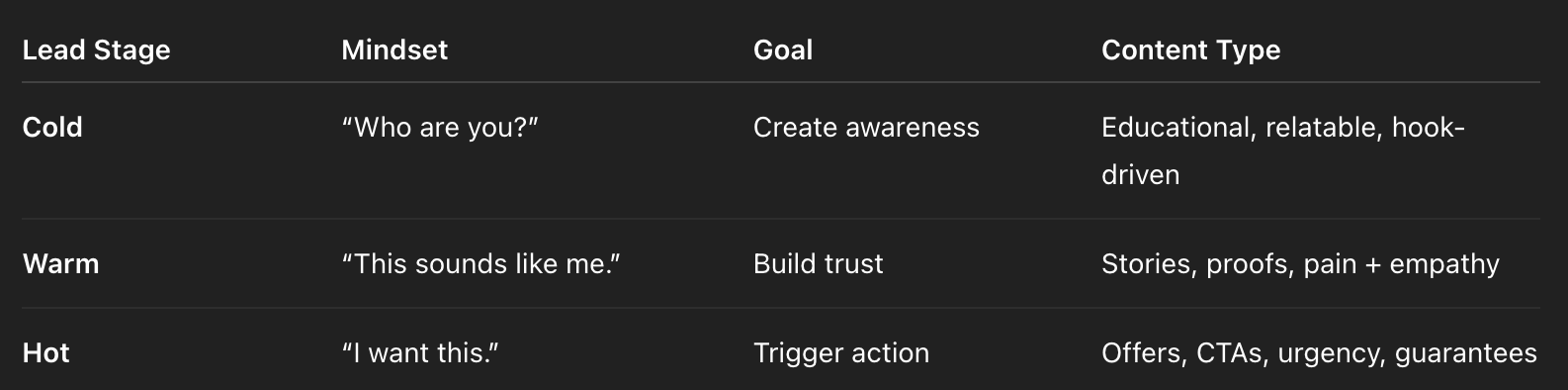
You’re not forcing the sale — you’re guiding belief.
Each stage has a psychological checkpoint, and skipping one kills conversions.
💡 Stage 1: From Awareness to Interest — The Stop-Scroll Moment
Cold leads live in a distracted world.
They’re scrolling, swiping, half-watching, half-listening.
To reach them, your first job isn’t to sell — it’s to make them pause.
Your Goal: Get them curious enough to care.
How:
Lead with relevance, not perfection.
Example: Instead of saying, “Join my workshop to learn productivity tools,”
say, “You’re not lazy. You’re just managing time the wrong way.”
→ The first sells; the second relates.Use pain as a magnet.
Your audience’s pain points are their entry points.
Frame your hooks around specific struggles:“Can’t focus for more than 20 minutes?”
“Still waiting for the ‘right time’ to start your course?”
Teach something tiny but valuable.
Give them a quick win early.
Example: share a 30-second reel solving one micro-problem.
Every solved problem earns you emotional equity.
💡 Stage 2: From Interest to Trust — Build Emotional Familiarity
Now that they know you, the next question they ask is — “But is this really for me?”
This is where creators win or lose. Your job here isn’t to impress; it’s to connect.
Your Goal: Build emotional trust through empathy and credibility.
How:
Use the PAS Formula (Problem → Agitate → Solve).
Show you understand their pain before you pitch your product.
Example:Problem: “You’ve tried every to-do app out there.”
Agitate: “But your list keeps growing while your energy keeps shrinking.”
Solve: “Here’s how creators actually stay consistent — even on low-energy days.”
Share your story.
People trust creators who show their own path. Share the “before” moments — the confusion, the burnout, the failure. That’s what trust feels like — wisdom from experience, not theory.Show small transformations.
Instead of vague “success,” show specifics:“A coach on TagMango went from 2 sales to 30 in 3 weeks — by adding one email sequence.”
Repeat your message — but repackage it.
Consistency creates familiarity. Familiarity creates trust.
💡 Stage 3: From Trust to Action — The Proof & Promise Combo
At this point, your audience believes in you — but not necessarily in the result.
They’re asking: “Can this really work for me?”
Your Goal: Replace doubt with belief.
How:
Show real proof.
Share screenshots, testimonials, DMs, transformations — not vague claims.
Proof doesn’t brag; it reassures.Show process, not just product.
Don’t only say what you achieved. Show how you did it.
Example: a creator showing the behind-the-scenes of scripting their course, not just the finished page.Use contrast storytelling.
People buy progress. Paint “Before → After” in every piece of content.Add the credibility anchor.
This could be metrics (“300 creators earned 10x more with X strategy”) or authority features (“Featured on…”).
💡 Stage 4: From Belief to Desire — The Irresistible Offer
Even if they believe it works, they’re now asking: “But why should I buy it from you?”
This is where you stop being another coach and become the obvious choice.
Your Goal: Make your offer feel like a no-brainer.
How:
Stack the value, not just the features.
Show what they get and what it’s worth.
Example:Core Course (₹4,999)
Bonus Worksheets (₹999)
Private Group Access (₹2,000)
→ Total Value ₹7,998 — Yours for ₹2,999.
Add a Guarantee or Safety Net.
Risk kills action. Safety drives it.
Example: “If you don’t learn XYZ in 7 days, get your money back.”Highlight transformation, not transaction.
Don’t sell a “course.” Sell a “change.”
Example: “Stop planning your time. Start owning it.”Use scarcity ethically.
Not “Only 2 seats left!” every week.
But real urgency like:“Enrollment closes Sunday midnight.”
“Next batch opens after 30 days.”
💡 Stage 5: From Desire to Decision — The Final Push
They’re on the fence. They’ve read your emails, watched your reels, maybe even added your course to the cart.
Now they’re hesitating — not because they don’t want it, but because they’re scared to commit.
Your Goal: Remove the last layer of fear.
How:
Speak to their self-doubt directly.
Example:
“You don’t need to be ‘ready.’ You just need to start.”
→ This turns hesitation into empowerment.Use a benefit-driven CTA.
Instead of “Enroll Now,” say:“Start Earning from Your Knowledge.”
“Get Your First Paying Client.”
“Build Your Audience in 30 Days.”
Send the final nudge.
Email or story reminders like:“Enrollment closes in 4 hours.”
“This is your sign to stop learning and start earning.”
⚙️ The Automation Layer — Nurture Without Nagging
You can’t manually talk to 500 cold leads every day. That’s where automation becomes your secret weapon — without losing the human touch.
Here’s a sample 3-email warmup sequence you can automate via TagMango:
Email 1 (Day 1): “The Relatable Hook”
Subject: “You don’t need more hours. You need a better plan.”
Content: Share their problem → empathize → quick win → CTA to free resource.
Email 2 (Day 3): “The Proof Email”
Subject: “How a creator earned ₹50k from one workshop.”
Content: Show real proof, teach a small takeaway → link to course or workshop.
Email 3 (Day 5): “The Invitation”
Subject: “You’re ready — here’s your next step.”
Content: Invite them to your offer → show value stack → add urgency.
Automation keeps you consistent — even when you’re offline. Consistency beats cleverness. Do this for 30 days, and you’ll notice your DMs, replies, and sales dashboards start warming up.
✅ Key Takeaways
You don’t “convert” cold leads. You nurture them.
Cold → Warm → Hot → Loyal is a journey, not a funnel hack.
Storytelling builds trust; consistency builds conversion.
Automation doesn’t replace empathy — it multiplies it.
The goal isn’t to sell more, but to believe with your audience.
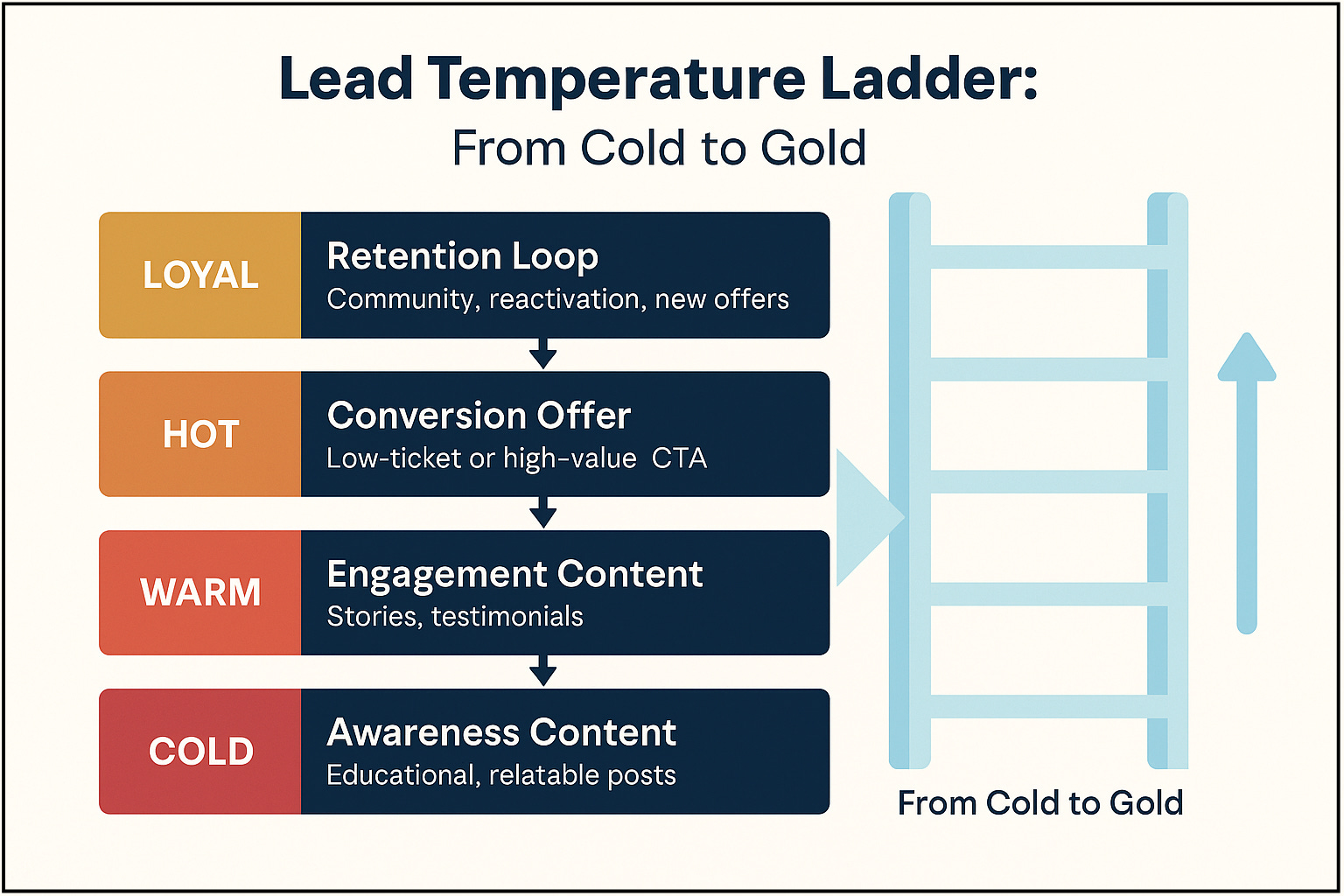
Every cold lead is just a conversation away from becoming your next success story. Nurture patiently, sell authentically, and let trust do the heavy lifting!